





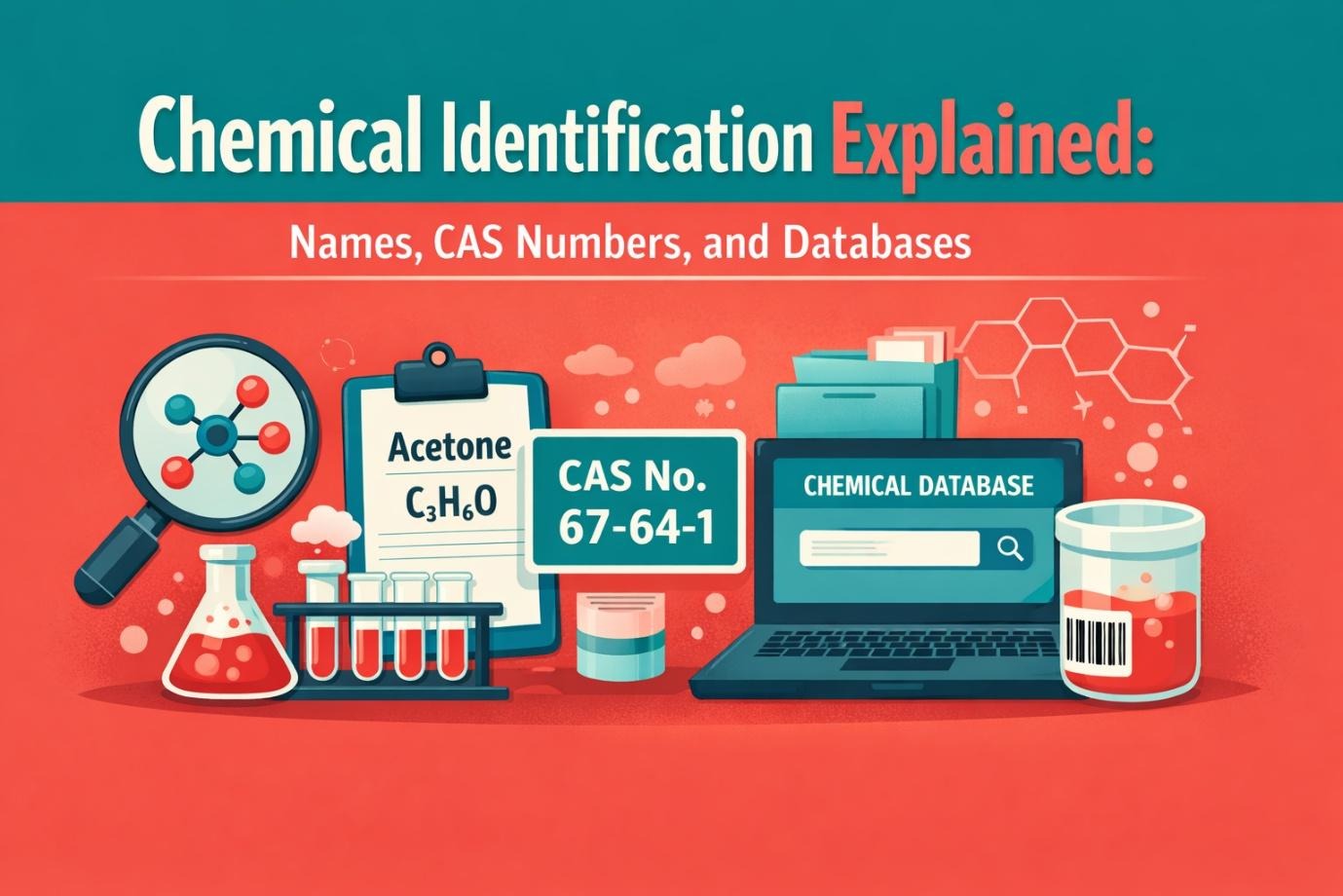
Chemical identification and naming are fundamental to science, manufacturing, regulation, and safety. Without a shared system for identifying substances, it would be impossible to ensure consistency across research, trade, regulatory compliance, or safety documentation. Clear chemical naming allows scientists, suppliers, regulators, and end users to speak the same language—regardless of geography or industry.
At the most basic level, a chemical can be identified by its common name, systematic (IUPAC) name, CAS Registry Number, molecular formula, and structural representation. Each serves a different purpose. Common names (such as “acetone” or “citric acid”) are widely used in industry and everyday contexts, but they can be ambiguous or language-dependent. For this reason, they are often supported by more formal identifiers.
The IUPAC name provides a systematic and internationally agreed method for naming chemicals based on their molecular structure. While precise, these names can be long and complex, making them less practical for routine use outside technical or academic settings. This is where numerical identifiers such as the CAS Registry Number become critical. A CAS number uniquely identifies a chemical substance and avoids confusion caused by synonyms, translations, or regional naming differences.
In practice, most chemicals are known by multiple names and identifiers. For example, a single substance may have a trade name, a common name, several synonyms, and one or more regulatory identifiers. Reliable databases play a key role in linking all of this information together and enabling accurate chemical identification.
Publicly accessible resources such as PubChem provide comprehensive chemical data, including names, synonyms, molecular structures, physical properties, and links to biological and toxicological information. PubChem is widely used by researchers and regulatory professionals as a trusted reference for verifying chemical identities and understanding how substances are described across different sources.
Other valuable resources are Common Chemistry and ChemSpider, which aggregates chemical information from hundreds of data sources. In particularly useful for exploring synonyms, alternative naming conventions, and supplier-used names, helping bridge the gap between academic nomenclature and commercial usage.
Accurate chemical identification is not just an academic exercise—it underpins safety data sheets (SDS), certificates of analysis (CoA), regulatory submissions, labelling, and supply chain traceability. Errors or inconsistencies in naming can lead to regulatory non-compliance, safety risks, or costly misunderstandings.
In a global chemical market, robust naming conventions and trusted reference databases ensure clarity, safety, and confidence—turning complex chemistry into shared, reliable knowledge.